"A few years ago, I never would have dreamed I'd make a motion for SewerAI."
What it takes to win board approval — drawn from two real meetings.
"A few years ago, I never would have dreamed I'd make a motion for SewerAI."
What it takes to win board approval — drawn from two real meetings.
That line was said out loud, on the record, at the City of Warsaw, Indiana Board of Public Works & Safety hearing on September 5, 2025 (SewerAI section starts at 1:04:22). Right before the board approved the motion anyway.
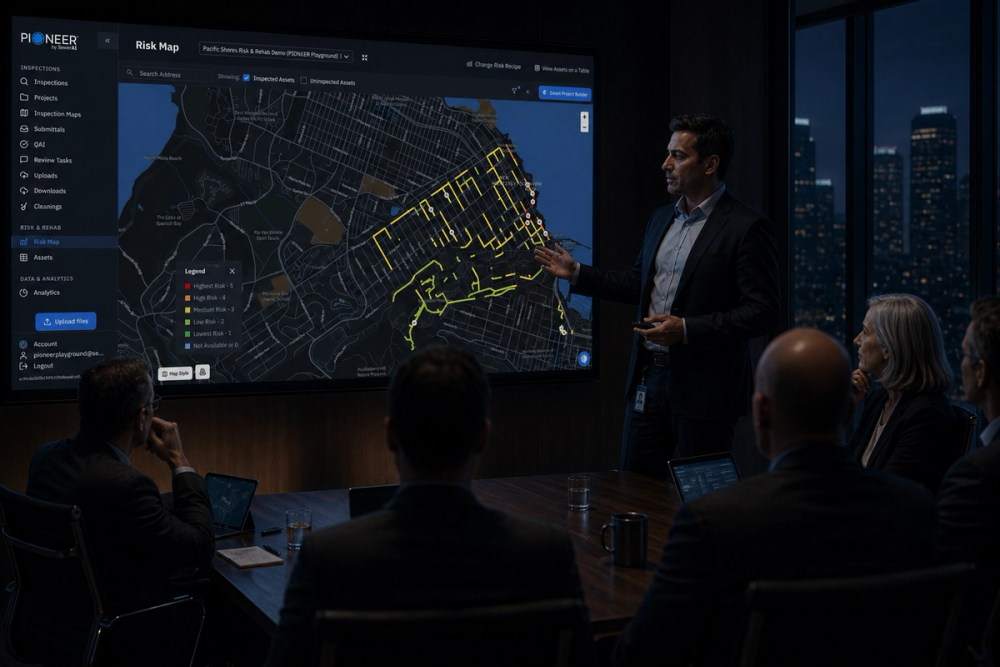
The contract in front of them: over 800,000 feet of pipe. Roughly 150 miles of collection system. Two pricing paths on the table: pay-as-you-go for each foot inspected, or a flat annual rate with unlimited grading. Full NASSCO-certified PACP scoring. Asset ranking. Rehab recommendations. Standing at the podium that day was Warsaw Utility Manager Brian Davison, walking the board through the contract himself. It's the cleanest public example we've seen of what actually happens in the room when a modernization pitch lands.
Seven months later, about 1,500 miles southwest, Mesa Water Resources Department Director Joseph Giudice stood in front of the Mesa City Council and reported back on Mesa's own AI inspection deployment (SewerAI section starts at 2:30:04). Different framing entirely. No approval to win — this was a retrospective. And his headline was the one every council wants to hear:
"We can now insource this work because we can do it at a lower cost than some of what our contract expenses are to do the same work from prior years."
Two utilities. Two board rooms. Two completely different framings. Both landed.
If you're a director, ops lead, or GIS manager preparing to make your own case, here's what worked in both rooms — and what you can use for your next board meeting.
Framing #1: The Data Gap (Warsaw)
Davison's pitch was built around a single, damning asymmetry:
"We have 100% of it videoed. Currently, we have maybe half of it actually graded. We don't have all the information we need to make better decisions, and this will give us that."
That's the whole pitch in two sentences.
The board doesn't have to understand PACP scoring, or machine learning, or what "coded inspection data" means. They understand gap. You have 150 miles of pipe on video. You can only defend condition decisions on 75 of them. That's the problem this contract fixes.
A few other moves worth copying from the Warsaw hearing:
Put the economics on the page, in plain English. Davison walked the board through both pricing paths — pay-as-you-go per foot, or a flat annual rate with unlimited grading — and named a specific break-even volume tied to Warsaw's actual inspection plan. The board didn't have to guess. They could pick the path that matched their own trajectory.
Position AI as consistency, not replacement.
"We have several people that are PACP certified and can grade it, but you may look at a crack, you can call it a crack, a fissure... Whether you agree with how it's graded or not, it'll all be consistent instead of having different people grade differently."
This is the single most important move for disarming the "AI concerns me" reaction that surfaces in every one of these meetings. Davison wasn't claiming AI is better than his people. He was claiming it makes every grade consistent — even on the pipe those people had already graded. That framing keeps the utility's expertise at the center of the story and turns AutoCode into a standardization tool instead of a threat.
Have the ongoing plan ready before they ask it. A board member asked: "At what point do we anticipate we'd have to film it again?" Davison had the answer before the question finished:
"Typically we'll take anything that's, say, a three or a four and we'll rerun it to see if that condition has gotten worse or stayed the same. If something grades out as a zero or one, we're probably not gonna waste our time going back through it unless we see a problem developing in those areas."
This is the difference between a one-time software purchase and an ongoing capital strategy. Boards feel that difference immediately. A closer on the same point from another member landed the same way: "I'm hoping we have an ongoing plan so we don't get where we were." Davison's response — "that's part of this, it's a tool to help us rank what we need to rehab next" — was the reassurance the whole room was waiting for.
What's sitting underneath that answer is worth copying: Warsaw's setup has Risk & Rehab running alongside the inspection stack from day one of the contract. Every clip uploaded refreshes the system's priority list automatically. So the next time a board member asks "where do we stand on rehab priorities?" — six months, twelve months out — the answer isn't a slide deck someone spent two weeks building. It's a live view. The list updates itself every time a truck uploads footage. That's a plan a board can keep funding, year after year.
Acknowledge the limits. Another board member flagged the garbage-in garbage-out concern out loud: "A program's only as good as the data you feed into it." Davison didn't deflect. He agreed — and he was right to. A program is only as good as the data fed into it. That's exactly why SewerAI is a cloud platform built around data standardization in the first place: so the way every inspection gets captured, formatted, and stored is consistent, no matter which operator ran the truck or which tool was on board that week. Davison then named the specific pipe that would get re-inspected first — segments near recent directional boring damage, some of which "takes years before we discover" the downstream consequences. Credibility gets built on what you concede, not just what you claim.
Framing #2: The Efficiency Story (Mesa)
Mesa's presentation was a different animal. Giudice wasn't pitching for approval — he was reporting back after deployment. But it's instructive because it shows exactly what a board wants to hear a year later.
His AI inspection segment lasted about ninety seconds, and it landed inside a broader narrative about operational improvements — a new water-recycler truck saving two million gallons and 30% of cleaning time in its first year, a joint smart-metering project with Mesa's gas and electric utility. AI inspection was presented as one more item in a portfolio of smarter-is-cheaper investments.
The framing:
"In the traditional past, we'd send cameras through. We'd sit down and we'd just go through the arduous task of watching that camera footage and looking for problems. AI technology helps us dramatically expedite that review time. It finds the problems and points them out to us so our staff don't have to spend the inordinate amount of hours going through the filming."
Hours recovered. Problems surfaced instead of hunted. And a minute later, Giudice tied that directly to the dollars:
"We can now insource this work because we can do it at a lower cost than some of what our contract expenses are to do the same work from prior years."
What Mesa is describing here isn't "we stopped using contractors." It's a specific shift for a specific task — AI-assisted inspection review — where Mesa's team can now handle work that used to require outside capacity. The utilities and contractors running SewerAI see this dynamic from opposite sides of the truck: utilities get inspection hours back; contractors process more footage per crew day. Both recover time that used to get burned at the manual-review bottleneck. The only thing that loses is the bottleneck itself.
That's the version of the argument every director should be building toward. Not we bought AI. Not we're modernizing. We're spending less time watching video and more time fixing pipe. Every council member in America understands that sentence.
Seven common threads worth stealing for your next board meeting
Strip Warsaw and Mesa down to the mechanics, and the same seven moves show up in both rooms:
1. Frame the gap first. AI second. Data gap, labor gap, cost gap — any of them work. Whichever is most visible on your council's last agenda is the right one to lead with.
2. Put the economics on the page. Break-even math. Per-foot rates. Contract costs avoided. Boards reject black-box pricing and approve transparent pricing.
3. Position AI as standardization, not replacement. Same defect scored the same way whether it's Tuesday or Friday, whether it's pipe segment 8 or 8,000. That honors your existing team instead of threatening them.
4. Come with the ongoing plan. Re-inspection cadence. Grade-3-and-4 prioritization. What triggers a rerun. Boards want to fund a system, not a pilot.
5. Be honest about the limits. Garbage in, garbage out. Old footage is old footage. Boring damage might not appear for years. Directors who concede these earn the credibility to be trusted on everything else.
6. Tie it to the efficiency story the council already believes. Mesa attached AI inspection to the same narrative as smart metering and the water-recycler truck. If your council is already bought into one modernization story, make AI inspection the next chapter — not a separate pitch.
7. Pre-brief the room. Warsaw Utility Manager Brian Davison had been championing the contract internally for a long time before it hit the agenda — and the board remembered. One member acknowledged it out loud during the hearing:
"Brian came to me a long time ago talking about the advantages of having this — the amount of coverage, the accuracy, and the dollars that will be saved by having it."
No one should hear your pitch for the first time in the board meeting.
Sewer infrastructure is the least glamorous, most consequential work in American public service. The directors running the meetings get to be the ones who modernize it — or the ones who don't. The difference between those two outcomes is rarely the technology. It's translating what the technology does into language a council already trusts. Brian did it with a data gap. Joseph did it with hours and dollars. Yours might be a compliance gap, a staffing gap, a consent decree clock — whichever one is already on your council's mind. Find the gap. Frame the gap. AI second.
Watch the meetings yourself. [Warsaw, September 5, 2025 →] · [Mesa, April 16, 2026 →]
Or see what Warsaw and Mesa are running. Book a demo →
STAY AHEAD OF THE FLOW
Get SewerAI updates, product news, and practical guidance for modern sewer inspection programs.