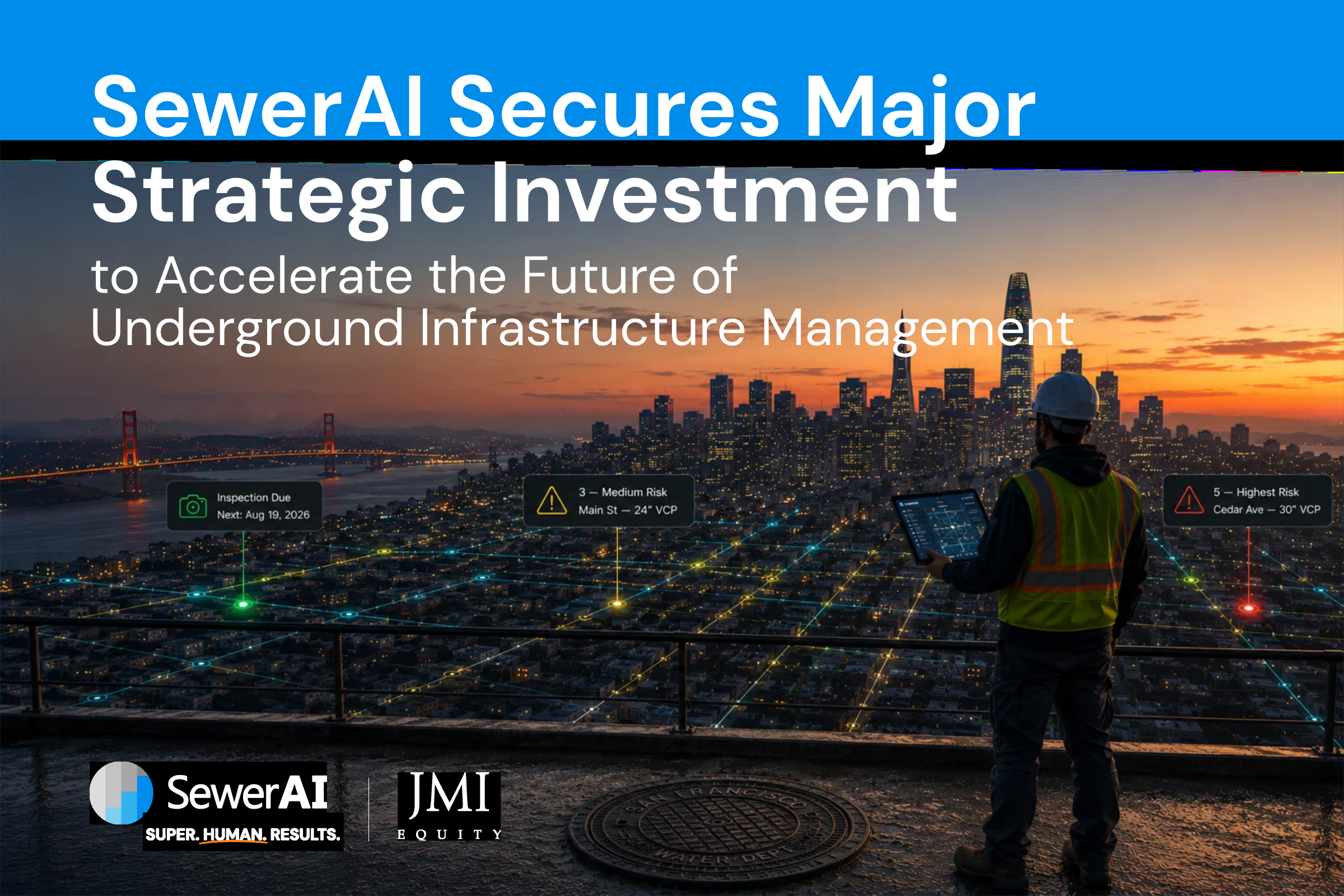
Why We Invested in SewerAI
Burnt Island Ventures Managing Partner Tom Ferguson explains why the firm invested in SewerAI, highlighting the overlooked but massive sewer inspection market and SewerAI's AI-powered solution.
At Burnt Island Ventures, we focus on water and environmental technology — sectors that are often underestimated by the broader venture capital community but represent some of the most critical infrastructure challenges of our time. When we first encountered SewerAI, it checked every box we look for: a massive, underserved market, a clear and painful inefficiency, and a technology-driven solution that could fundamentally change how the industry operates.
An Overlooked Market Hiding Beneath Our Feet
We love markets that are overlooked, and sewer inspection is one of those markets. And it's not just because they lie beneath our feet. The US sewer system covers 1.3 million miles — over 6 billion feet — and almost all of us barely give it a second thought. Yet every foot of that pipe has to be inspected on a regular basis, usually once every six years, to ensure the network remains safe, functional, and compliant.
Sewer infrastructure is aging across the United States. The American Society of Civil Engineers has consistently given the country's wastewater infrastructure a near-failing grade. Municipalities are under increasing pressure to identify and remediate defects before they become catastrophic failures — sinkholes, sewage overflows, and environmental contamination. The stakes are high, and the inspection mandate is non-negotiable.
The Inefficiency of Manual Video Review
Inspections are carried out by camera-equipped robots that crawl through sewer pipes, recording footage as they go. The process moves at roughly 400 feet per hour — and every foot of that footage currently has to be reviewed more or less in real-time by a trained technician who assesses faults, grades defects, and logs findings according to standardized coding systems.
This is an extraordinarily labor-intensive process. Skilled reviewers are in short supply, the work is tedious and prone to human error, and the cost of review adds up quickly when you're talking about billions of feet of pipe. Municipalities and contractors are caught in a cycle: they need more inspections, but the bottleneck of manual review limits how fast they can process footage and act on findings.
The result is a market that is simultaneously enormous and deeply inefficient — exactly the kind of opportunity that gets us excited.
The Scale of the Problem
To put the scale in perspective, consider the numbers:
- 1.3 million miles of sewer pipe in the United States alone
- Over 6 billion feet of pipe requiring periodic inspection
- Inspection cycles of approximately once every six years per segment
- Camera inspection speed of roughly 400 feet per hour
- Every hour of footage reviewed manually, in near real-time, by a trained technician
The math is staggering. Even at a conservative estimate, the total labor hours required to keep up with the inspection and review cycle across the US represent a multi-billion dollar market — and that's before accounting for the downstream costs of deferred maintenance, emergency repairs, and regulatory penalties.
How SewerAI Solves It: AutoCode and AI-Powered Defect Detection
SewerAI has built an AI-powered computer vision platform — AutoCode — that automates the defect detection and coding process. Instead of requiring a technician to watch every frame of footage in real-time, AutoCode analyzes inspection video automatically, identifies defects, and generates standardized condition reports at a fraction of the time and cost of manual review.
The platform is trained on a vast library of sewer inspection footage and is capable of recognizing the full range of defect types defined by industry coding standards. It doesn't just flag anomalies — it classifies them, grades their severity, and produces the structured output that municipalities and contractors need to prioritize repairs and meet regulatory requirements.
The efficiency gains are dramatic. What once took hours of skilled human review can now be processed in a fraction of the time, with consistent accuracy and without the fatigue-related errors that inevitably creep into manual workflows. For contractors, this means faster turnaround and the ability to take on more work. For municipalities, it means faster access to actionable data and lower overall inspection costs.
Why Burnt Island Ventures Invested
Burnt Island Ventures was founded on the conviction that water and environmental infrastructure represent one of the most important — and most underfunded — areas for venture investment. We look for companies that are applying modern technology to solve problems that have been stuck in the same operational patterns for decades. SewerAI fits that thesis precisely.
Several factors made this investment compelling for us:
- A large, non-discretionary market: Sewer inspection is mandated. Municipalities cannot opt out. The demand is structural and recurring.
- A clear and quantifiable pain point: The manual review bottleneck is well understood by every participant in the market. SewerAI's value proposition is immediately legible to customers.
- A defensible technology moat: Training AI models on sewer inspection footage requires access to large, labeled datasets. SewerAI has built that asset over time, creating a competitive advantage that is difficult to replicate quickly.
- A strong team with deep domain expertise: The SewerAI team combines experience in computer vision, machine learning, and the water infrastructure industry — a rare combination that gives them both technical credibility and market insight.
The Broader Opportunity: AI in Infrastructure Inspection
SewerAI's approach points to a much larger opportunity. Across the built environment — water mains, stormwater systems, bridges, roads, pipelines — there are vast inspection and maintenance workflows that remain largely manual, paper-based, and inefficient. AI-powered computer vision is poised to transform all of them.
Sewer inspection is a particularly attractive beachhead: the data is structured (standardized coding systems), the workflow is well-defined, and the customer base — municipalities and inspection contractors — is large and geographically distributed. A company that earns trust and builds market share here has a strong foundation from which to expand into adjacent inspection categories.
We believe SewerAI is building the platform that will define how AI is applied to underground infrastructure inspection — not just in the US, but globally. We're proud to be partners in that journey.
This post is based on the original investment thesis published by Burnt Island Ventures. Read the original post on the Burnt Island Ventures blog.
Burns & McDonnell and SewerAI Announce Strategic Partnership to Help Utilities Modernize Infrastructure Management

SewerAI Launches Command Center: Turning Inspection Data Into Reports, Maps, and Rehab Plans in Minutes